BBC (Broad Biomechanical Correspondence) Technology - the
effect of varying pin settings on
the operation of MyoQuip machines
MyoQuip's BBC Technology is designed as
a compensation mechanism for biomechanical disadvantage.
When a limb is fully flexed, i.e., the foot
or hand is close to the trunk, the muscles of
that limb are operating in a position of considerable
biomechanical disadvantage, but as the limb
extends away from the trunk it moves into a
progressively more biomechanically efficient
orientation.
An example of this changing biomechanical efficiency
can be seen with the barbell squat. When the
hip and knee joints are flexed as in the deep
position of the squat, the lifter's capacity
to cope with resistance is considerably reduced;
but as they rise and the joints fully extend,
the amount of resistance that can be coped with
increases dramatically. This is why there is
a very strong tendency for unsupervised and
inexperienced lifters to perform only partial
squats and why the squat does not effectively
work the leg extensor muscles through their
full range.
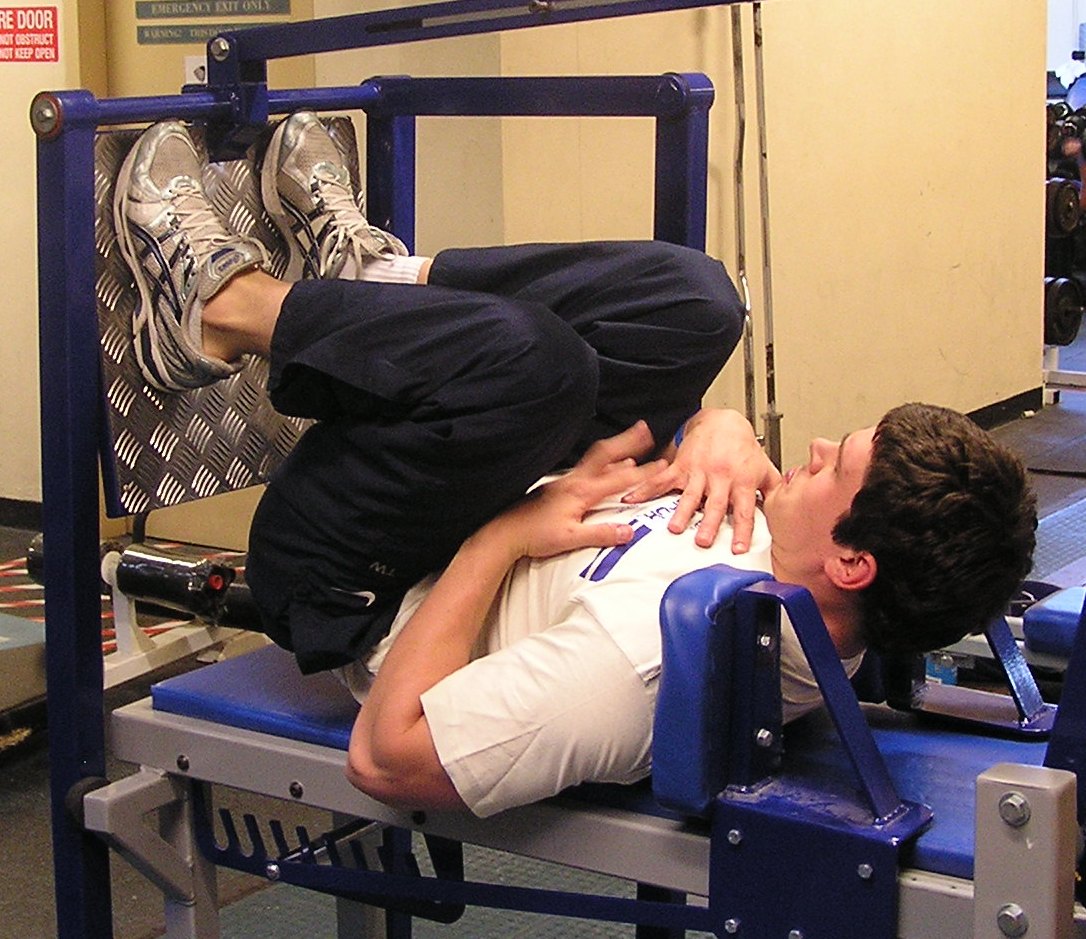
MyoQuip's
machines such as the MyoThrusta and the MyoTruk use Broad Biomechanical
Correspondence Technology to provide increasing resistance throughout
the exercise movement. This enables the exerciser to operate
comfortably and effectively in the region of biomechanical
disadvantage. In addition the technology exposes them to substantial
effective loading and high-range muscle fibre recruitment throughout
the whole range of movement.
The rate at which the effective resistance
changes is varied by selecting different pin
positions on the machine's adjustment bar.
Mid-range pin settings
These
are designed to broadly compensate for the improvement in biomechanical
advantage throughout the exercise movement. The increase in effective
load from the start of the movement to full lockout is intended to
match the body's capacity to handle resistance, so that the exerciser
has to expend basically the same degree of effort throughout the
movement; in other words to provide broad biomechanical correspondence
between the exerciser's load-bearing capacity and the effective load.
This can be contrasted with the barbell squat where considerable effort
is required at the bottom of the movement and very little at the top
end.
Thus with a mid-range pin setting on apparatus such as the MyoThrusta the leg
extensor muscles experience substantial activation
throughout the whole range of movement.
Low-range pin settings
Here the increase in effective load from start
to finish of the exercise movement is greatly
increased. These notch settings are ideal for
practising explosive or ballistic movements.
The exerciser chooses a weight load they can
comfortably handle at the start of the movement
and then attempts to perform the concentric
part of the exercise as rapidly as possible.
However, as they move toward full leg extension
the effective load is rapidly increasing thus
slowing their momentum. As a result there is
a "ballistic braking" effect toward the end
of the movement, eliminating the need to decelerate.
Because of this the exerciser can utilise explosive
strength over the full range of the movement.
This range of settings is particularly useful
with the MyoThrusta where concentration on
plyometric-type movements can be expected to
produce significant improvements in vertical
leap.
High-range pin settings
The increase in effective load from start to
finish of the exercise movement is greatly reduced.
High pin settings are ideal when the focus is
on overcoming inertia, i.e., moving a heavy
load from a position of rest. A typical real
world application is in rugby when there is
the need to "shunt" the opposing pack. A similar
situation applies in the rugby lineout when
a lifter with poor vertical jumping ability
has to be rapidly hoisted.
High-range pin settings are also useful when
the MyoTruk or MyoThrusta is being used
to improve performance in the barbell squat,
because the additional loading at the start
of the movement conditions the leg extensors
to operate more effectively in the region of
greatest biomechanical disadvantage, e.g., in
the deep squat position.