Email MyoQuip
for quotes and other product information
Please
bookmark this site and come back often
MyoQuip HipneeFlex accommodating
resistance strength builder for hip and knee
flexors
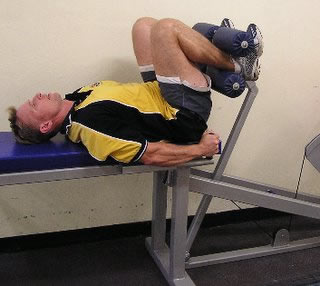
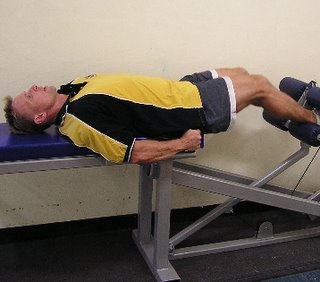
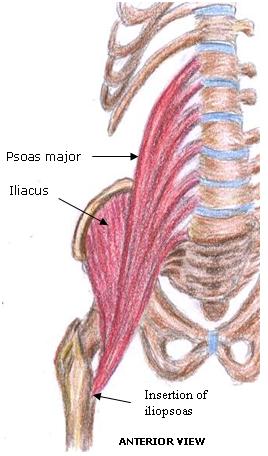
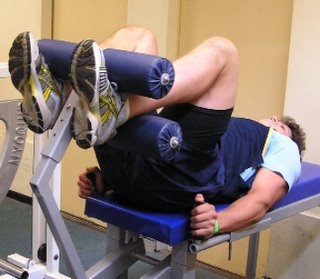
The MyoQuip HipneeFlex is a truly unique apparatus for the development of the hip and knee flexors. Figure 1 shows its basic mechanism. The athlete operates from a supine position so that the action of the flexors - the iliopsoas and hamstrings for the hip and knee joints respectively - can be effectively isolated.The feet are engaged between rollers which are cable-connected to the weighted QuadTorq mechanism.
The exercise movement involves the feet being drawn back from a fully extended position to a
fully flexed position. Thus both hip and knee flexors are exercised through a range where the
included angle at the joints varies from 180º to around 30º.
The arc through which the foot engagement device moves is designed to closely parallel the path that the feet would normally traverse if drawn back without resistance. It also creates a natural tendency for the two joint angles to vary synchronously so that they are both under continual load.
Biomechanical correspondence
In going from full extension to full flexion the limb joints are moving towards a progressively inferior biomechanical orientation and consequently, less capacity to handle load.In view of this the QuadTorq mechanism for the HipneeFlex is configured for decreasing resistance. (This is opposite to MyoQuip's other machines such as the MyoTruk and MyoThrusta. Because they involve limb extension rather than limb flexion, the orientation of their BBC mechanism is for increasing resistance.)
Hamstring
development
It could be argued that
other exercises and apparatus cater adequately for
hamstring development. For example, in their role
as hip flexors, they are strongly activated in
whole-leg extensor movements such as the barbell
squat. But with regard to their other function as
knee flexors the most commonly used apparatus, the
leg curl machine, doesn't usually involve knee
joint closure much below 90º and it is also a
simple single-joint exercise.
By contrast, many of the important sporting
activities involving the knee flexor, such as
sprinting, cycling or rowing, produce acute joint
angles and also require complex coordination
between the hamstrings and iliopsoas. The
HipneeFlex is the only strength apparatus that
effectively simulates that coordination.
"... an apparatus that
can safely and effectively strengthen a muscle
group that is intrinsically involved in many
athletic and sporting activities but which is
virtually never developed to its full
potential."
Hip flexor strength and
sport
Strong hip flexors provide an
advantage in a wide range of sports and athletic
activities. In sprinting high knee lift is
associated with increased stride length and
therefore considerable attention is given to
exercising the hip flexors. However, they are
usually not exercised against resistance and
consequently there is unlikely to be any
appreciable strength increase.
Hip flexor strength is directly relevant to a
range of activities in football. Kicking a ball is
a complex coordinated action involving
simultaneous knee extension and hip flexion, so
developing a more powerful kick requires exercises
applicable to these muscle groups. Strong hip
flexors can also be very advantageous in the
tackle situation in American football and both
rugby union and rugby league where a player is
attempting to take further steps forward with an
opposing player clinging to his legs.
In addition those players in American football
and rugby who have massively developed quadriceps
and gluteus muscles are often unable to generate
rapid knee lift and hence tend to shuffle around
the field. Having stronger flexors would
significantly improve their mobility.
It is commonly asserted that marked strength
disparity between hip extensors and hip flexors
may be a contributing factor in hamstring injuries
in footballers. It is interesting to speculate on
whether hip extensor/flexor imbalance might also
be associated with the relatively high incidence
of groin injuries.
"... in any sporting
activities requiring hip joint extension, the hip
flexors perform a crucial antagonist function. For
example, ... in controlling the rate of descent
and ascent in ... the squat. "
Iliopsoas strengthening has specific
performance implications for cycling which
involves continuous though offsetting leg
extension and flexion. Enhanced hip flexor
capacity has particular relevance to the cycling
upstroke where both hip and knee joints are
flexing. Concentration on using the hip flexors
takes load off the hamstrings, the most overworked
muscles in cycling.
Cross country skiing is particularly taxing on
the hip flexors, as are other activities involving
vertical movement of the body such as cross
country running and mountain climbing.
Some of the more athletic forms of dance also
necessitate very strong hip flexors.
More generally, in any sporting activities
requiring hip joint extension, the hip flexors
perform a crucial antagonist function. For
example, both hip and knee flexors perform a vital
role in controlling the rate of descent and ascent
in leg extension exercises such as the squat.
Tight hip
flexors are recognised as contributing
to lower back pain by causing the pelvis to tip
forward. Full range activation of the iliopsoas
through use of the HipneeFlex can be expected to
have a beneficial effect on flexor
flexibility.
Specific hip flexor
development
Until recently the hip flexors
have been the most neglected muscle group in
strength training. The development of the
HipneeFlex provides a machine with significant
specificity to the natural movement of these muscles,
involves their full-range activation and has a high degree of biomechanical correspondence
between effective load and load-bearing capacity
of those muscles at a particular limb
position.
Athletes and their coaches constantly seek
minor improvements that could conceivably give
them a competitive edge. Here we have an apparatus
that can safely and effectively strengthen a
muscle group that is intrinsically involved in
many athletic and sporting activities but which is
virtually never developed to its full
potential.
For further information or to obtain a quotation please
email Bruce
Ross. If you are located outside Australia we can quote in your own
currency with alternative shipment options.